Advanced lighting basics: biology, spectrum, UGR and UV-BHow it really
works.
The biology of the eye and the body clock, spectrum and CRI, the UGR formula, haze in the eye and UV-B. With numbers and sources.
Eye, clock
and shape.
Three sensors in the eye, a clock that runs by the light, and shadows that draw the shape.
Three sensors.
Two pathways.
Light enters the eye and does two things at once: it builds the image and sets the clock in your head.
- Conescolours and detail
- Rodsvision in dim light
- Melanopsin cellswhether it is day
Colours and detail.
Three kinds: for red, green and blue. This is what CRI matters for.
Seeing in low light.
Very sensitive, but colourless. That is why the world turns grey at night.
A time-of-day sensor.
Cells discovered in 2002. They do not form an image: they measure how much light there is. Most sensitive to blue, around 480 nm.
A clock in your head.
The melanopsin signal goes to the biological clock in the hypothalamus. It sets sleep, alertness, hormones and body temperature.
The clock runs
on light.
This is how much light at the eye scientists recommend: a lot by day, little in the evening, almost none at night.
The brain knows it is day.
Plenty of bright light in the eyes: alertness rises, the day and night rhythm stays steady, and falling asleep in the evening is easier.
Bright light steals sleep.
Bright, cool light in the eyes suppresses melatonin, the sleep hormone. The clock shifts and it is harder to rest.
The eye defends itself.
The same cells constrict the pupil. A bright spot in the field of view is work for the eye, even when you do not feel it.
Light in the eyes is what counts.
The clock reacts to light that enters the eye. A luminaire with a hidden source gives plenty of light on the table and little in the eyes.
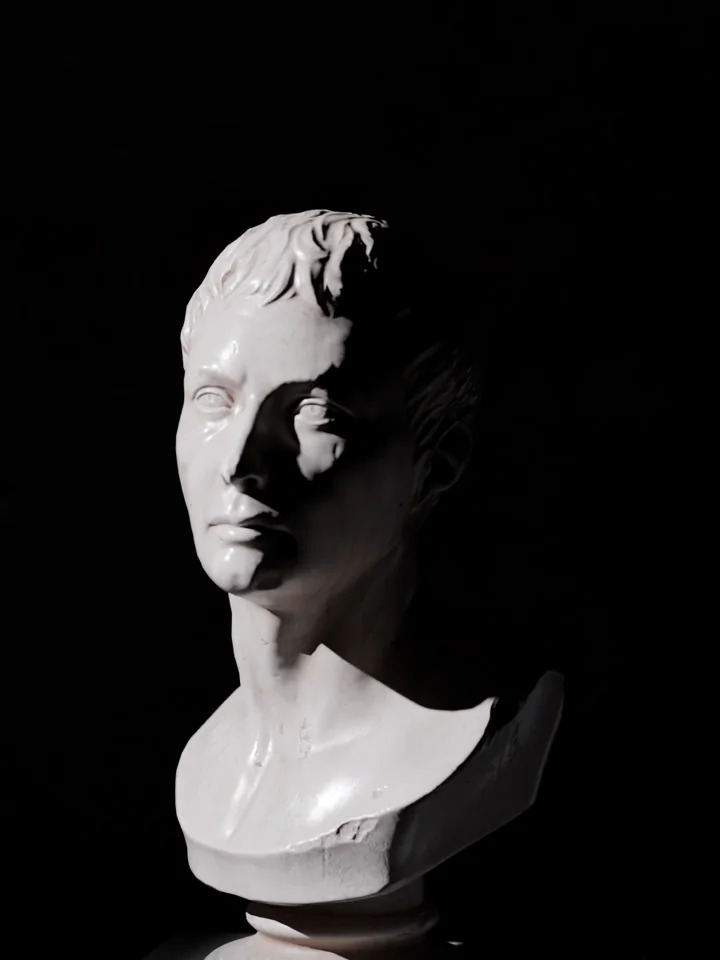
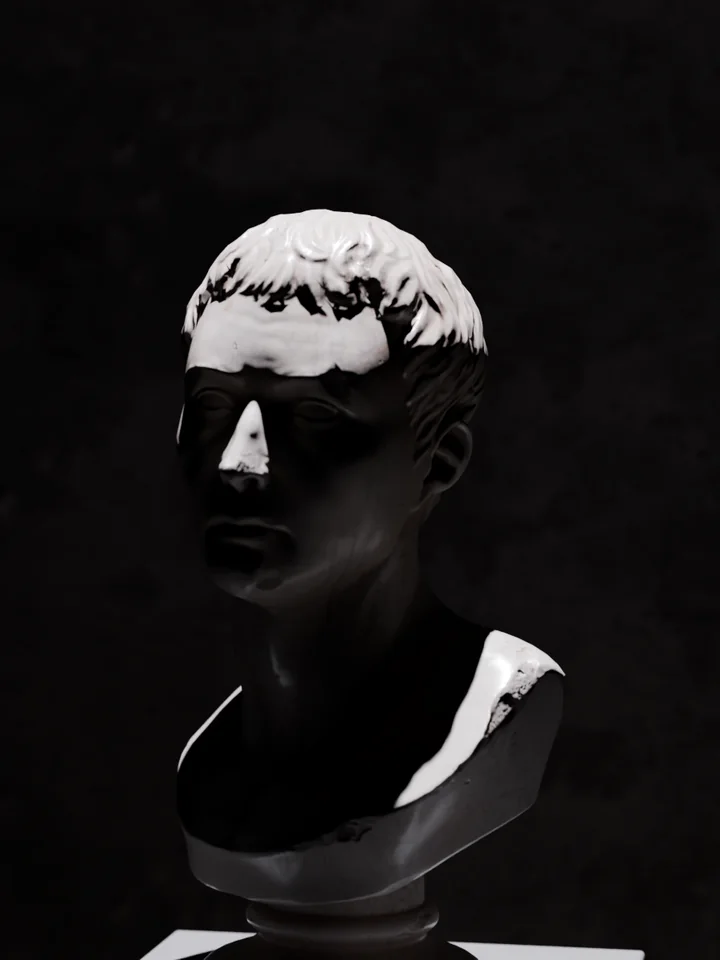
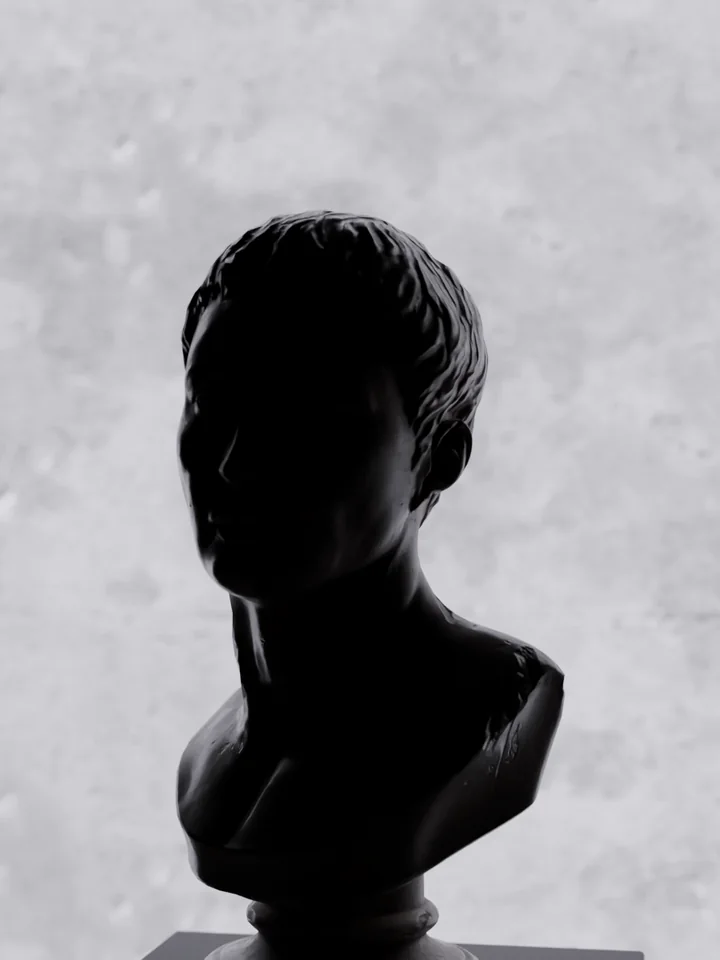
The same marble.
Four lights.
Only the direction of the light changes. The sculpture and the camera stay where they are.

Form from shadow.
Light from one direction draws shadows and shows texture. Light from everywhere at once flattens objects and faces.
Colour is light.
An object reflects only what it receives. When red is missing from the lamp spectrum, red fades. CRI measures this.
Conversation is expression.
Soft light on the faces at the table shows smiles and eyes. A bright lamp behind the person opposite turns them into a dark silhouette.
Bright where it matters.
A bright table and a darker surrounding focus attention and calm you down. A warm colour in the evening lets the body slow down.
Where CRI
comes from.
CRI is calculated from the spectrum of the luminaire: how much light it gives in each colour. Here you can see what a typical LED is missing.
Colour is light.
Here the red is missing.
An object reflects only what it gets from the lamp. A typical LED emits almost no deep red.
R1–R14left half: typical LED, right half: FREI
- R179
97 - R288
100 - R394
92 - R480
99 - R578
98 - R684
98 - R783
98 - R858
97 - R92
96 - R1071
95 - R1178
98 - R1260
83 - R1381
98 - R1496
94
Where glare
comes from.
Source brightness, haze in the eye and the formula from the standard. Everything behind the single UGR number.
An opal line is
50 times brighter than the plate.
You see the world as reflected light. A lamp shines straight into the eye.
Luminance in candela per square metre, typical values. Logarithmic scale: each step is 10 times more.
The world is reflected light.
The lamp lights the table, the table reflects part of that light, and only this reflection reaches the eye. A white plate on the table has a luminance of about 100 candela per square metre.
The source hits the eye directly.
When you can see the glowing part of a lamp, nothing softens the light on its way. An opal diffuser has several thousand candela per square metre, a bare LED millions. That is hundreds of times more than the table.
The eye knows one such source: the sun.
For millions of years of evolution the only point this bright hung high in the sky. Brows and eyelids shield the eye from light above. A lamp at eye level gets around this protection.
More light.
You see less.
A bright point scatters inside the eye and lays a haze over the whole image. Slide and compare.
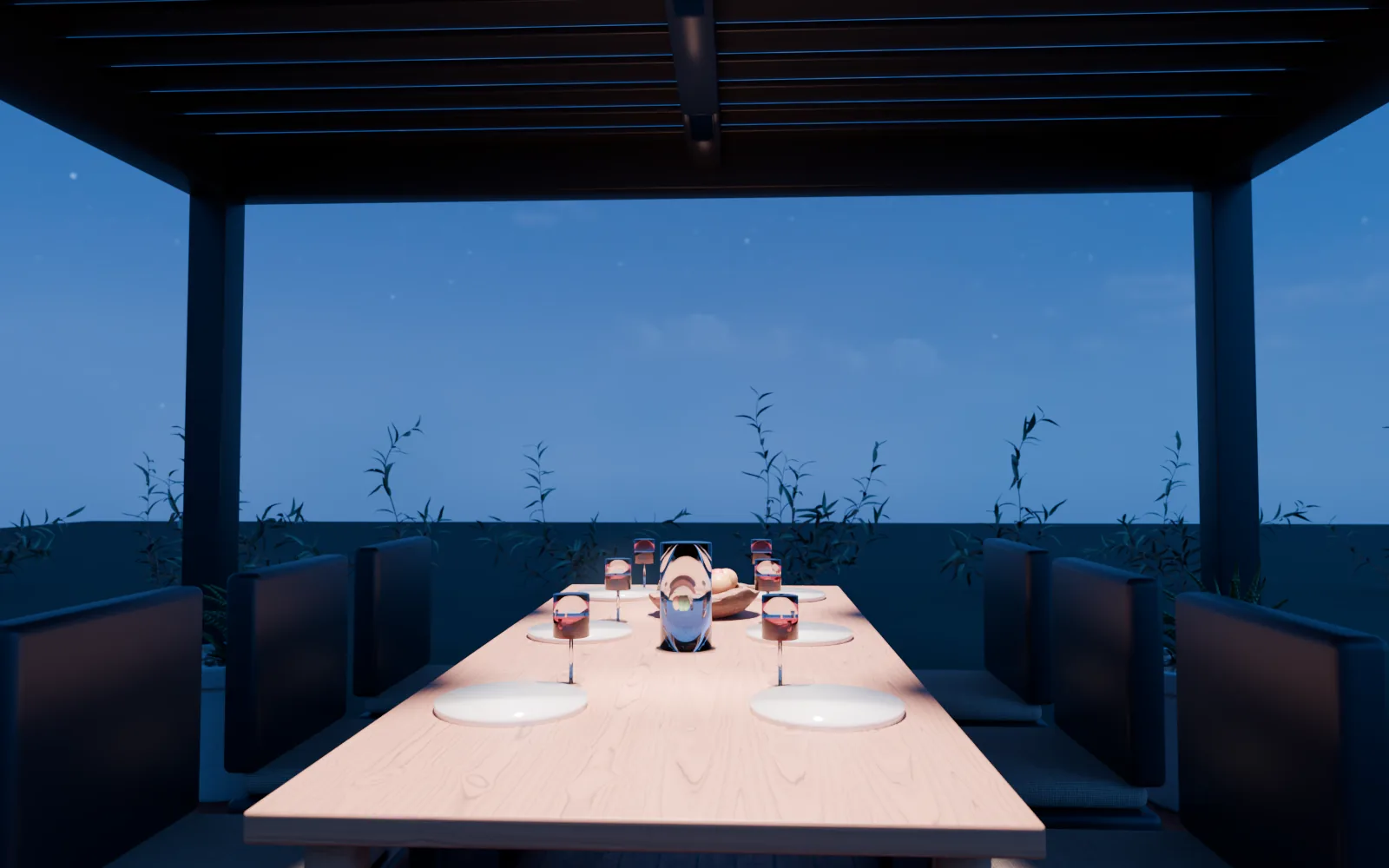 Luminaire in the field of viewHidden source
Contrast drops.
A bright spot scatters in the lens and inside the eye. A bright haze covers the whole image: there is more light, yet you see worse.
The eyes are working.
The pupil constricts, you squint, the muscles around the eye tense up. After an hour your eyes are tired and your head aches.
Light can hurt.
Research links glare to the trigeminal nerve, which senses pain in the eye and face. Melanopsin cells have a pathway to pain centres in the brain: that is why light hurts during a migraine.
You look at the lamp.
The eye keeps returning to the brightest spot. Instead of the person opposite and the plate, your gaze keeps drifting to the glowing strip.
An opal line without optics easily goes above 28. A line with the source set back in the profile, like the one in our acoustic booths, does not dazzle. Sources: CIE 117 (UGR), Noseda et al., Nature Neuroscience 2010.
Winter sun.
Indoors?
Vitamin D is produced in the skin under the influence of UV-B rays from the sun. From October to March the sun in Poland is too low for the skin to produce enough of it.
The sun has UV-B.
A white LED does not.
Vitamin D is triggered by a narrow band of rays below 315 nm. An ordinary LED lamp emits nothing there.
The invisible part of sunlight. It is what triggers vitamin D in the skin.
White LEDs, including those in FREI luminaires, do not emit UV-B. On their own they will not give you vitamin D.
A new direction: a small, calculated dose of UV-B where people spend the winter indoors.
Too much UV-B burns the skin and harms the eyes. The dose has to be safe, and supplementation is a decision for a doctor.
Ask before you buy.
Tell us what you are lighting. We will give you the CRI, UGR, lux and flicker for your place before the first luminaire goes up.